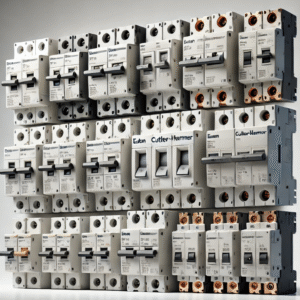
In today’s automotive retail environment, car dealerships operate more like mini–industrial campuses than simple showrooms. Between the service bays, body shops, parts warehouses, lighting, HVAC, sales offices, and increasingly electric vehicle (EV) charging stations, the electrical load is complex, heavy, and mission-critical. To protect that infrastructure, maintain uptime, and ensure safety, high quality circuit breakers are essential. Eaton’s Cutler-Hammer line of circuit breakers is one of the most trusted in commercial and industrial settings. In this article, we’ll explore why a car dealership should seriously consider using Eaton / Cutler-Hammer breakers, what advantages they bring, what challenges dealerships must manage, and how these devices support the evolving demands of auto retail — especially in the era of EVs.
The Electrical Demands of a Modern Car Dealership
A car dealership is not just a place to sell vehicles. It is a combination of:
-
Showrooms with extensive lighting, display systems, and climate control
-
Offices with computers, phone systems, networking, and security systems
-
Service bays and lifts powering motors, compressors, welding gear, and diagnostic equipment
-
Paint shops and spray booths with strong ventilation and specialized power
-
Parts storage, warehousing, and sometimes small fabrication or machine shops
-
Electric vehicle charging stations (Level 2, and often DC fast) as more EVs are sold
-
HVAC systems, compressors, lighting, and sometimes rooftop solar or backup generation
Because of this, the facility’s electrical infrastructure must be robust, segmented, and capable of protecting multiple types of loads — from sensitive electronics to heavy motors. Any fault, overload, or short circuit can cause major downtime, safety hazards, and significant repair costs.
If a dealership fails to invest in a reliable overcurrent protection system, it risks equipment damage, fire, interruption of operations, or liability exposure.
What Makes Eaton / Cutler-Hammer Breakers Stand Out
Eaton (which owns the Cutler-Hammer brand) is a globally recognized name in power management solutions. Their circuit breakers are widely used in industrial, commercial, and mission-critical settings. Here are several reasons why a dealership would select Eaton / Cutler-Hammer over lower-end or generic breakers:
Reliability and long life
Eaton breakers are engineered to high standards. Their molded-case breakers (among many other product lines) offer solid performance in thermal/magnetic designs for overload and short-circuit protection. Eaton+1 Industrial users often choose Eaton because of reputation for longevity and consistency across high duty cycles. When a breaker rarely fails, the risk of unexpected outages is reduced.
Wide variety and compatibility
Eaton offers numerous models (single-pole, two-pole, three-pole, ground fault, arc fault, etc.), with a broad range of current ratings and voltage classes. Relectric+1 That flexibility is crucial in a dealership, where the same facility might house both 120 V circuits (lighting, outlets) and heavier 480 V or 240 V circuits (motors, compressors, HVAC). Having a common manufacturer simplifies spares, maintenance, and training.
Safety, certification, and standards compliance
Cutler-Hammer breakers are UL listed and designed to meet rigorous standards. Their trip curves and interrupting capacity are tested. This matters heavily in code inspections, third-party auditors, insurance, and liability. Using a well-respected brand reduces the risk that a breaker fails in a noncompliant or borderline way.
Easy servicing and parts availability
Because Eaton / Cutler-Hammer are common in many sectors, parts, replacement units, and technical support are more readily available. This reduces downtime when a breaker must be replaced or serviced.
Arc fault and ground fault protection
In sensitive circuits (e.g. in offices, customer areas, or control rooms), Eaton offers arc-fault and ground-fault circuit breakers that detect dangerous arcing or leakage currents, tripping before a fire can start. This extra layer of protection is an advantage in mixed-use commercial spaces.
Scalability and future proofing
As a dealership expands — adding more bays, EV chargers, or auxiliary loads — Eaton’s scalable breaker lines make it easier to upgrade. Instead of replacing the entire panel, you can add more modules or upgrade individual circuits.
Why Standard or Budget Breakers Often Fall Short in the Dealership Environment
While generic circuit breakers may suffice in simple residential settings, dealerships bring special challenges:
High fault currents and heavy motors
The service shop houses large motors, compressors, welders, lifts, and other load equipment. These loads can draw large inrush currents and may generate fault events. A cheap breaker may not have the interrupting rating or thermal robustness to handle such surges, leading to nuisance tripping or even failure.
Mixed loads and sensitivity
A facility might have sensitive electronics (control units, computers, networking) on the same floor or panel as heavy machinery. A wrongly sized or low-quality breaker could lead to voltage dips, harmonics, or protection that is too coarse, risking damage to sensitive components.
Safety and regulatory risk
If a fire or arc fault incident occurs, investigators and insurance firms will look at the quality and compliance of protective devices. Using recognized, certified equipment like Eaton / Cutler-Hammer helps demonstrate due diligence in safety practices.
Rapid upgrades to EV infrastructure
Many dealerships are under pressure to add EV chargers. For example, Blink’s blog points out that many dealerships must upgrade their electrical capacity to support Level 2 and DC fast charging. Blink Charging That means high current circuits, dedicated feeds, and robust protection must be designed in — something generic breakers may struggle to support reliably.
Complexity of maintenance
In a busy dealership environment, maintenance must often be done quickly and safely. Eaton’s consistent product lines, documentation, and interchangeability make it easier for electricians to maintain systems without frequent surprises.
How Cutler-Hammer / Eaton Breakers Fit Into the Dealership Electrical Strategy
Zoning the facility
Dealerships should be divided into zones (e.g. showroom, service bays, body shop, parts, EV charging). Each zone can have its own breaker panels, feeders, and protection strategy. Eaton’s modular breaker designs allow tailored protection per zone, with coordination.
Coordination and selectivity
To minimize the impact of a fault, breakers should be selectively coordinated: only the breaker closest to the fault opens, not plunging the entire facility offline. Eaton offers time-delay, selective, and coordination options in their product lines, which help protect downstream devices and keep unaffected zones powered.
Spare capacity and future expansion
When installing panels and breaker slots, design with spare capacity (20–30 %) for future expansion (e.g. adding more chargers or new service bays). Eaton’s breakers come in modular sizes, so it’s easier to occupy those spare slots.
Redundancy and backup systems
Many modern dealerships run backup generator systems or uninterruptible power supplies (UPS) for critical control, sales, and customer areas. Eaton is a leader in power management, so its breakers and coordination strategies integrate well with backup systems.
Maintenance & testing
Dealerships should follow periodic testing and inspection of overcurrent protection devices. Breakers should be exercised, tested under load, and (if required) calibrated. Because Eaton has clear data sheets, replacement guides, and support, maintenance personnel can reliably manage the system.
Real-World Business Drivers
Minimize downtime = preserve revenue
Every hour that the service bays are down, repairs or refurbs aren’t delivered, costing both revenue and customer trust. Using high-quality breakers reduces the probability of unplanned outages due to protective device failure.
Insurance and liability protection
Insurance underwriters often favor quality components in high value operations. In event of a fire, having Eaton / Cutler-Hammer breakers helps show that the facility used industry-standard safety devices.
Support for EV push
Dealerships are increasingly judged by how well they support EV buyers and charging infrastructure. As the automotive world transitions, facilities must keep pace. Upgrades in electrical power, breakers, panels, and infrastructure often become a gating factor. As one recent industry article notes, dealerships investing in EV service must also invest heavily in their electrical systems. CBT News+2Alvarez & Marsal+2
Facility modernization and branding
Many dealerships are undergoing significant renovations to modernize their look, integrate new tech, and improve efficiency. As Kerrigan Advisors reports, “dealerships across the country are undergoing a major transformation” in showrooms, service areas, and customer experience features. kerriganadvisors.com A facility that shows attention to the backend systems (electrical, safety, infrastructure) supports the brand experience.
Example Use Cases in a Dealership
-
Service bay feed protection: A 3-pole breaker feeding a group of lifts or compressed air motors, sized with appropriate interrupt capacity for motor inrush and fault levels.
-
Paint booth circuits: Specialized circuits supplying ventilation fans, heater elements, spray booths — with selective coordination and ground-fault protection.
-
Lighting and showroom circuits: Smaller, well protected circuits (arc fault or ground fault breakers) safeguarding lighting, display, networking, and acoustics gear.
-
EV charger feeders: Dedicated circuits to Level 2 or DC fast chargers, possibly 208/480 V. Eaton’s breakers allow robust protection for such high load devices.
-
Emergency / backup circuits: Panel segments tied to generator or UPS systems, with Eaton breakers that manage manual and automatic transfer switching.
Addressing Common Concerns
-
Cost vs. budget breakers: Yes, Eaton / Cutler-Hammer have a higher upfront cost, but that premium pays off in reliability, reduced downtime, and smoother maintenance.
-
Compatibility with existing panels: Careful matching is needed. Some older or competitor panels may restrict which breaker types are allowed. However, Eaton offers many models and adapters to bridge compatibility gaps. ElectricPro Insights+1
-
Training and familiarity: Maintenance staff need to be trained on Eaton breaker characteristics, trip curves, and testing protocols. But the strong documentation and support ecosystem makes this manageable.
-
Future expansion: The modular and scalable nature of Eaton systems helps avoid lock-in while supporting evolution of the facility.
Conclusion
A car dealership is an infrastructure-intensive enterprise. To maintain uptime, safety, and flexibility in a competitive industry — especially one that’s rapidly evolving toward electrification — investing in robust, trusted electrical protection is not optional. Eaton Cutler Hammer circuit breakers deliver reliability, breadth of options, safety compliance, and future scalability that make them well suited for dealership use. Whether protecting motors in the service bays, feeding EV chargers, or guarding sensitive electronics in showrooms and offices, they are a key element in a dealership’s long-term infrastructure strategy.
When dealership executives ask, “Why Eaton / Cutler-Hammer breakers?” the answer is: because the cost of failure is too high, and for critical facilities, trust in power protection isn’t negotiable. ⚡